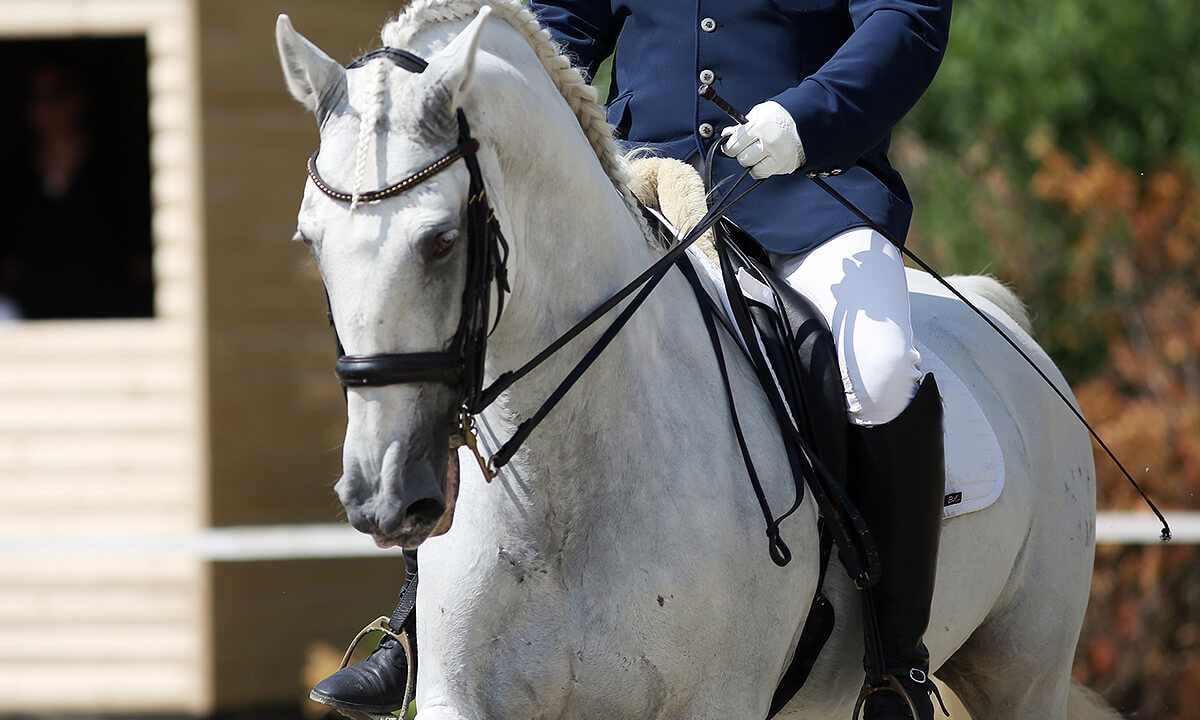
A double bridle, also called a Weymouth bridle, is designed to hold two bits each with a set of reins.
Double bridles have a cavesson noseband attached to a slip head that passes through the browband and sits underneath the headpiece of the bridle to which a curb (bridoon) bit is attached. The cavesson noseband is a single strap of leather that fits around the horse's muzzle. Another slip head passed through the browband under the cavesson slip head then attaches to a snaffle (weymouth) bit. One set of reins is attached to each bit, with the reins on the snaffle bit being wider than the reins attached to the curb bit.
Fitting A Double Bridle
The snaffle bit should lie over the top of curb bit with the snaffle bit sitting comfortably across the toothless gap between the incisors and molars of the horse and the curb bit the positioned 1/4 to 1/2 inch below the snaffle bit. The headpiece of the bridle should sit comfortably behind the horse's poll with the browband positioned approximately the width of two fingers below the ears to avoid it pinching.
The cavesson noseband should be adjusted so that it lies approximately half way between the corners of the mouth and the cheekbone of the horse. The cavesson noseband should not be fastened too tight, but should allow two fingers to be easily inserted between the noseband and the front of the horse's nose. The curb chain should be placed behind the chin groove of the horse, ensuring that it lies flat and is not twisted, and the leather lip strap should pass through the loose link in the middle of the curb chain and fastened. The curb chain should be adjusted so that when the shanks on the curb bit are pulled back to a 45 degree angle the chain applies pressure to the chin groove and when the shanks are released the pressure is removed.